

Executive Summary
Artificial intelligence has become the most consequential general-purpose technology of our era, yet its benefits are flowing overwhelmingly to dense urban markets and to a handful of well-capitalized technology firms. Rural America — and rural South Carolina in particular — risks being left on the wrong side of a new and widening “intelligence divide.” This White Paper argues that the same cooperative model that brought electricity, telephone service, and increasingly broadband to rural communities in the twentieth century can now bring advanced artificial intelligence to those same communities in the twenty-first. We propose the AI Cooperative Operating System (AI-Coop OS): a community-owned platform, governed democratically by its members, that runs capable open-weight AI models on local infrastructure and delivers practical intelligence services to farms, factories, schools, clinics, and civic institutions.
The economic case is compelling. A regional cooperative can stand up a production-grade AI platform for an estimated $75,000 to $95,000 in first-year capital and operating cost, then sustain it for roughly $30,000 to $40,000 per year thereafter. By contrast, equipping the same institutions with commercial per-seat and per-token AI services can exceed $120,000 per year for comparable organization-wide usage — with none of the resulting assets, data, or capabilities remaining under local control. As Figure 6 illustrates, a cooperative typically reaches cost break-even within the first year and accumulates substantial savings thereafter, all while keeping member data, jobs, and decision-making inside the community.
The AI-Coop OS is built on a simple but powerful architecture. A single capable base model stays resident in GPU memory, while lightweight, swappable LoRA adapters and retrieval indexes specialize the system for each domain — agriculture one moment, legal document preparation the next — loading in one to two seconds. This design lets a modest two-node server with consumer-class 24 GB GPUs deliver expert-level assistance across many fields at a fraction of the hardware cost of a general-purpose data center.
This White Paper makes the case in full. It quantifies the rural technology gap, details a practical governance and financing structure, specifies current and accurate hardware and model recommendations, presents four grounded case studies with concrete cost and efficiency figures, and lays out an actionable five-year roadmap and a set of implementable policy recommendations. The central conclusion is that locally governed AI cooperatives are technically achievable today, economically advantageous within a single budget cycle, and strategically essential to the long-term resilience and prosperity of rural communities.
Purpose and Motivation: The Rural AI Imperative
The question facing rural leaders is no longer whether artificial intelligence will reshape their local economies, but who will own the intelligence and the infrastructure that does the reshaping. This analysis establishes why community ownership is both urgent and uniquely suited to rural conditions.
The Widening Digital and Intelligence Divide
Rural communities continue to face a persistent connectivity gap that now threatens to become an intelligence gap. As of 2025, the Federal Communications Commission reported that roughly 19.6 million Americans lack access to fixed broadband meeting the 100/20 Mbps standard; independent audits place the true figure closer to 26 million once over-reported provider coverage is corrected [1]. In 32 states the urban-rural speed gap actually widened in 2024, and in some states barely 31% of rural users reach 100/20 Mbps service compared with roughly 68% of urban users [1].
South Carolina offers both a cautionary tale and a hopeful precedent. The state began its broadband push in 2021 with more than 300,000 unserved or underserved locations; through disciplined, data-driven public-private partnership it had reduced that number to 28,724 locations by April 2025 and is deploying $546.5 million in federal BEAD funding to connect the remainder [2]. That success demonstrates two things at once: rural infrastructure gaps are real and severe, and coordinated community-scale action can close them. The AI-Coop OS applies precisely that lesson to the next frontier — computation and intelligence rather than mere connectivity.
The stakes are economic and demographic. The same rural counties that struggled with connectivity are those experiencing population decline, hospital closures, and the erosion of local expertise as professionals retire or relocate. Left unaddressed, the intelligence divide compounds these trends: businesses that cannot access AI-driven productivity fall behind, and the value created by AI accrues to distant shareholders rather than local member-owners.
The Rising Cost and Dependency of Frontier AI
Commercial AI is powerful but expensive, opaque, and structurally centralizing. Flagship model APIs in early 2026 charge on the order of $1.75 to $5.00 per million input tokens and $12 to $25 per million output tokens [3]; per-seat subscriptions range from $20 to $200 per user per month, with enterprise governance features layered on top [3]. For an organization with dozens of daily users and document-heavy, agentic workflows — where conversation history is re-sent on every turn — these metered costs compound quickly and unpredictably.
Beyond cost, dependency on external providers introduces three risks that rural institutions can ill afford. First, continuity risk: pricing, model behavior, and availability can change without notice, and a discontinued model can break workflows overnight. Second, data-sovereignty risk: sensitive agricultural, medical, legal, and civic data leaves the community entirely. Third, capability-capture risk: the expertise, tooling, and economic upside of AI accumulate outside the region. Community ownership directly mitigates all three.
The Cooperative Opportunity
Rural America already possesses the institutional DNA for community-owned infrastructure. The nation’s 890 rural electric cooperatives serve roughly 42 million people across 48 states, own about 42% of the nation’s electric distribution lines, hold more than $213 billion in assets, and return over $1 billion annually to their consumer-members [4]. Critically, these cooperatives serve 92% of the nation’s persistent-poverty counties [4] — exactly the communities most at risk of being excluded from the AI economy. The governance structures, member trust, billing relationships, and even the physical facilities of these cooperatives provide a ready foundation on which an AI cooperative can be built.
The opportunity, in short, is to treat artificial intelligence as essential shared infrastructure — like power lines or broadband — rather than as a product to be rented indefinitely from distant vendors. The remainder of this White Paper describes exactly how to seize it.
The AI Cooperative Concept
An AI cooperative is a member-owned, democratically governed enterprise whose purpose is to acquire, operate, and continuously improve shared artificial-intelligence capabilities on behalf of its community. It adheres to the seven internationally recognized cooperative principles — voluntary membership, democratic member control, member economic participation, autonomy, education, cooperation among cooperatives, and concern for community — applied to the domain of computation and intelligence [5].
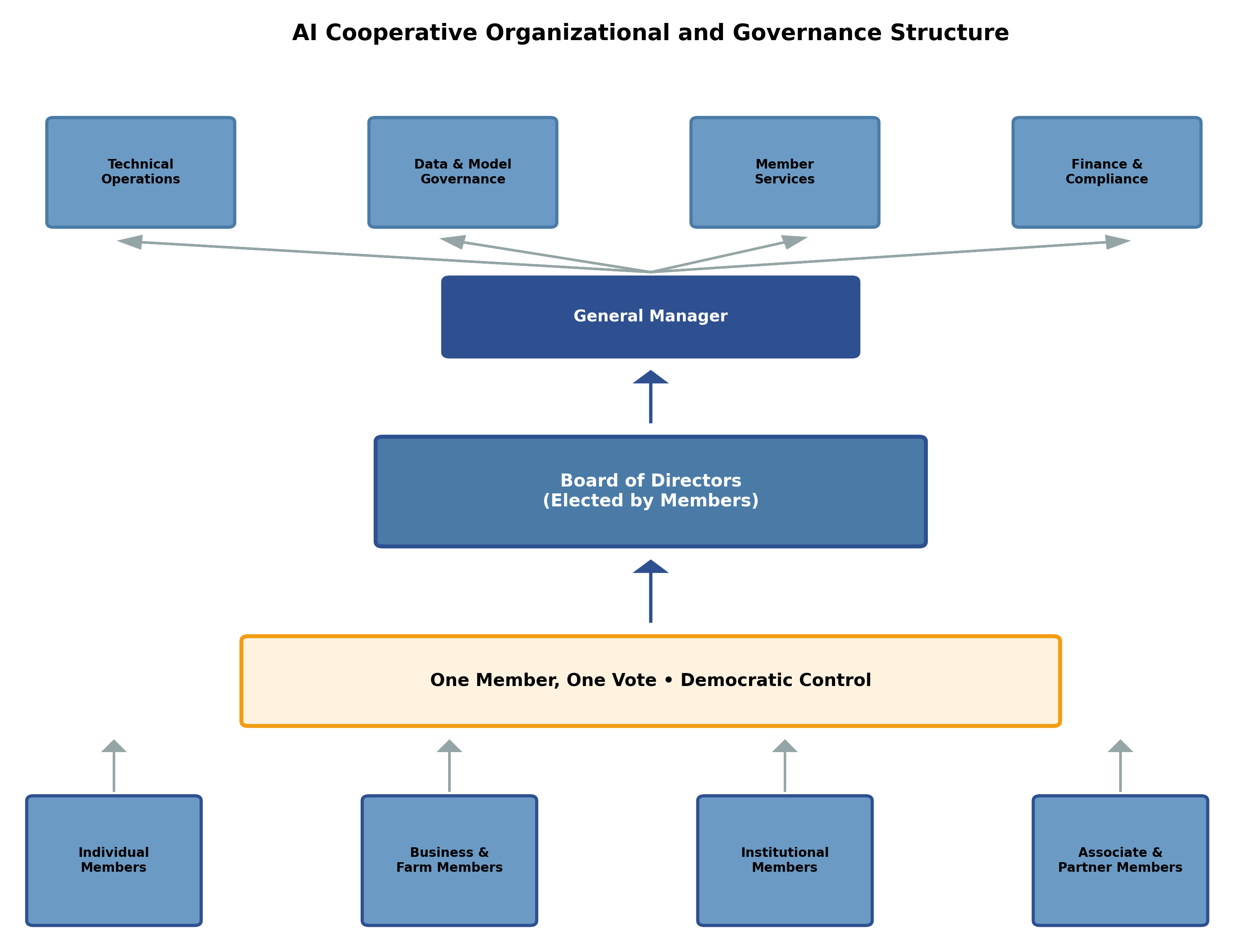
Figure 1. AI Cooperative organizational and governance structure, showing member-owner control, an elected board, professional management, and four operational units.
Governance and Membership
Governance follows the proven one-member, one-vote model rather than the one-share-one-vote model of investor-owned firms, ensuring that a large agribusiness and an individual resident have equal voice in the cooperative’s direction. Members democratically elect a Board of Directors, which sets strategy and policy and hires a General Manager to run day-to-day operations. As shown in Figure 1, the cooperative organizes its work into four operational units — Technical Operations, Data and Model Governance, Member Services, and Finance and Compliance — each accountable to the manager and, ultimately, to the membership.
The cooperative recognizes four membership classes so that its structure mirrors the community it serves. Individual members (residents, students, sole proprietors) gain affordable access to AI tools and a democratic vote. Business and farm members integrate AI into commercial operations and typically contribute larger patronage. Institutional members — school districts, clinics, local governments, libraries — deploy AI for public service. Associate and partner members, including universities and existing electric or telephone cooperatives, provide expertise, facilities, or financing without controlling governance. This structure balances broad inclusion with financial sustainability.
Revenue Models and Financial Sustainability
A durable AI cooperative blends several revenue streams so that no single source is indispensable. Recurring membership dues and tiered usage fees cover baseline operating costs; institutional service contracts with school districts, county governments, and clinics provide predictable anchor revenue; grant and cooperative-financing programs fund capital equipment; and modest fee-for-service professional offerings (custom adapter training, data-preparation services) capture value from advanced needs. Consistent with cooperative principles, any surplus is either reinvested in capacity or returned to members as patronage dividends in proportion to their use of the service.
Data Ownership, Privacy, and Liability
Data governance is the cooperative’s defining advantage. Member data remains the property of the member and the collective, never leaving cooperative-controlled infrastructure and never being sold or used to train third-party commercial models. The Data and Model Governance unit maintains clear consent, retention, and access policies, and every model invocation is logged for auditability (see Figure 3). For higher-stakes domains such as legal or health-adjacent assistance, the cooperative adopts a strict human-in-the-loop standard: AI drafts and retrieves, but a qualified human reviews and bears final responsibility. Clear terms of service and professional liability coverage delineate the boundary between decision-support and professional advice.
Cybersecurity, Insurance, and Resilience
Because the platform runs on local infrastructure, the cooperative controls its own security posture: network segmentation, encrypted storage, role-based access control, and regular third-party audits. On-premises operation also confers resilience — core services can continue during internet outages, a meaningful advantage in rural areas prone to connectivity disruptions. The cooperative carries cyber-liability, general-liability, and professional (errors-and-omissions) insurance sized to its service mix, and maintains documented incident-response and disaster-recovery procedures.
Partnerships
No cooperative operates in isolation. Strategic partnerships with land-grant universities, technical colleges, existing electric and telephone cooperatives, the USDA Rural Utilities Service, and open-source AI communities provide expertise, shared infrastructure, workforce pipelines, and access to public financing. The principle of cooperation among cooperatives further enables federation — the subject of the AI Cooperative Operating System and Figure 4 — in which multiple regional AI cooperatives share model improvements while retaining local autonomy.
The AI Cooperative Operating System
The AI-Coop OS is best understood by analogy to a computer operating system. Just as an OS manages finite CPU, memory, and storage to run many applications on shared hardware, the AI-Coop OS manages finite GPU memory, model weights, adapters, and retrieval indexes to deliver many specialized capabilities on shared infrastructure. It is the orchestration layer that turns a rack of servers into a community intelligence utility.
Design Philosophy
Three principles guide the design. Efficiency through specialization: rather than paying for one enormous general model to do everything, the system keeps a single capable base model resident and specializes it on demand. Transparency by default: every request is routed, served, and logged through auditable components the cooperative controls. Graceful degradation and augmentation: the platform runs fully on local hardware for everyday work, yet can optionally “burst” to cooperative or commercial cloud resources for rare, exceptionally demanding tasks — complementing, never replacing, local capability.
Layered Architecture
As Figure 2 shows, the AI-Coop OS is organized into five layers. The Infrastructure Layer provides GPU servers, storage, and networking, with optional hybrid cloud burst. The Knowledge Layer holds retrieval indexes, a vector database, and curated regional datasets. The Capability Layer contains the resident base model plus a library of swappable LoRA adapters and domain modules. The Orchestration Layer — the heart of the system — routes requests, schedules work, manages GPU memory, and enforces policy and audit logging. Finally, the Application Layer exposes domain-specific interfaces for agriculture, manufacturing, education, legal assistance, and civic services.
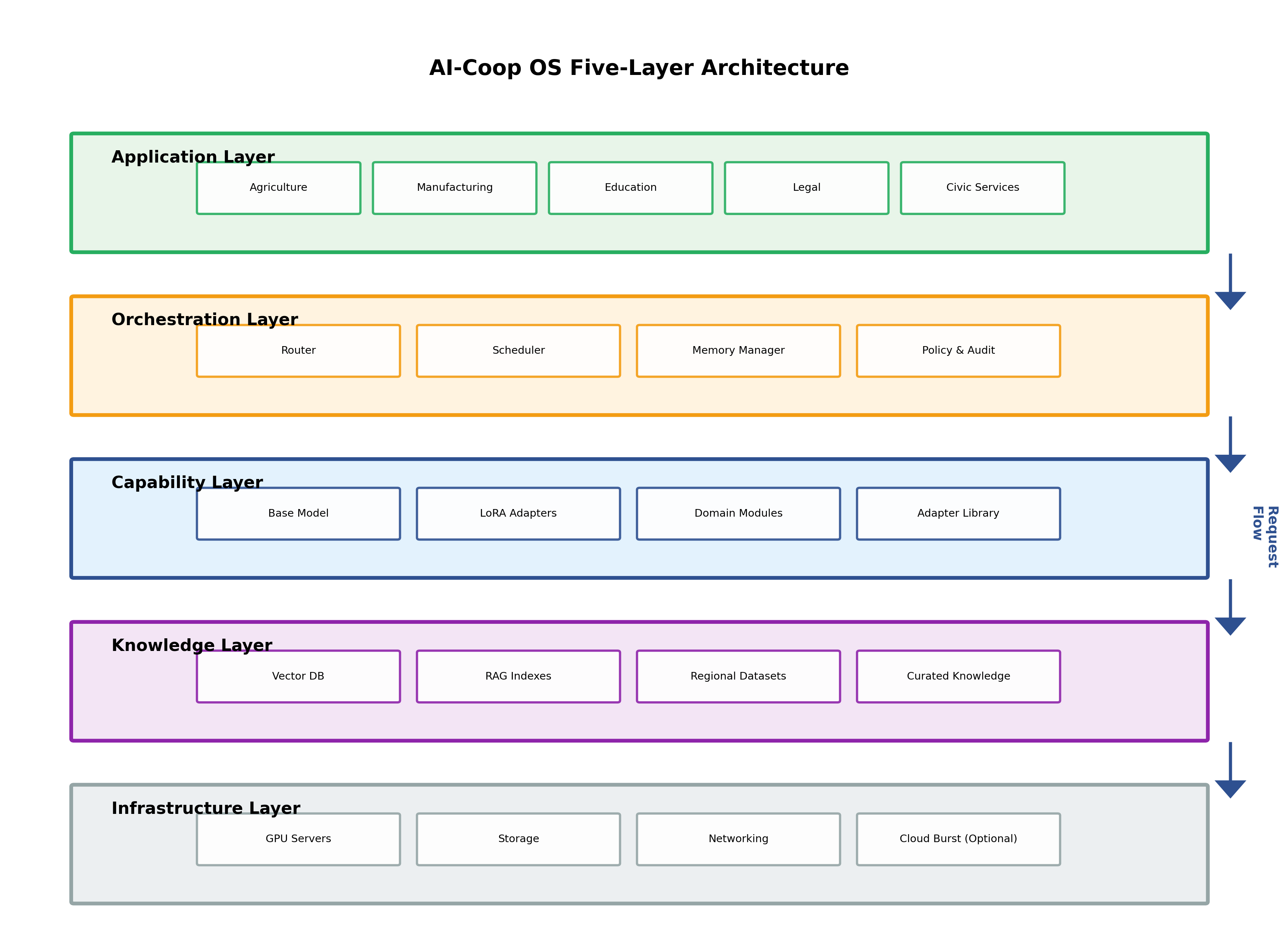
Figure 2. The five-layer AI-Coop OS architecture. Requests flow from member-facing applications down through orchestration to specialized capabilities and local infrastructure.
The Orchestration Layer
The orchestration layer performs the same essential function as an operating-system kernel and resource manager. Its router classifies each incoming request by domain and selects the appropriate adapter and retrieval index. Its scheduler queues and batches work to maximize GPU throughput. Its memory manager keeps the base model resident while loading and evicting lightweight adapters from VRAM according to demand — much as an OS pages memory. Its policy and audit component enforces access control, records every invocation, and applies safety and human-in-the-loop rules where required.
Dynamic Model and Adapter Swapping
The swapping workflow, depicted in Figure 3, is what makes broad capability affordable. A base model such as an 8-billion- or 70-billion-parameter open-weight model remains loaded continuously. When a request arrives, the router identifies the relevant domain; if the needed adapter is already cached in GPU memory, inference proceeds immediately, and if not, the corresponding LoRA adapter — typically only tens to a few hundred megabytes — is loaded in roughly one to two seconds. Retrieval-augmented generation then grounds the response in the cooperative’s curated local knowledge, and the result is returned along with an audit-log entry. Because only small adapters swap while the large base model stays put, a single modest server can offer expert behavior across dozens of domains without the cost of hosting dozens of full models.
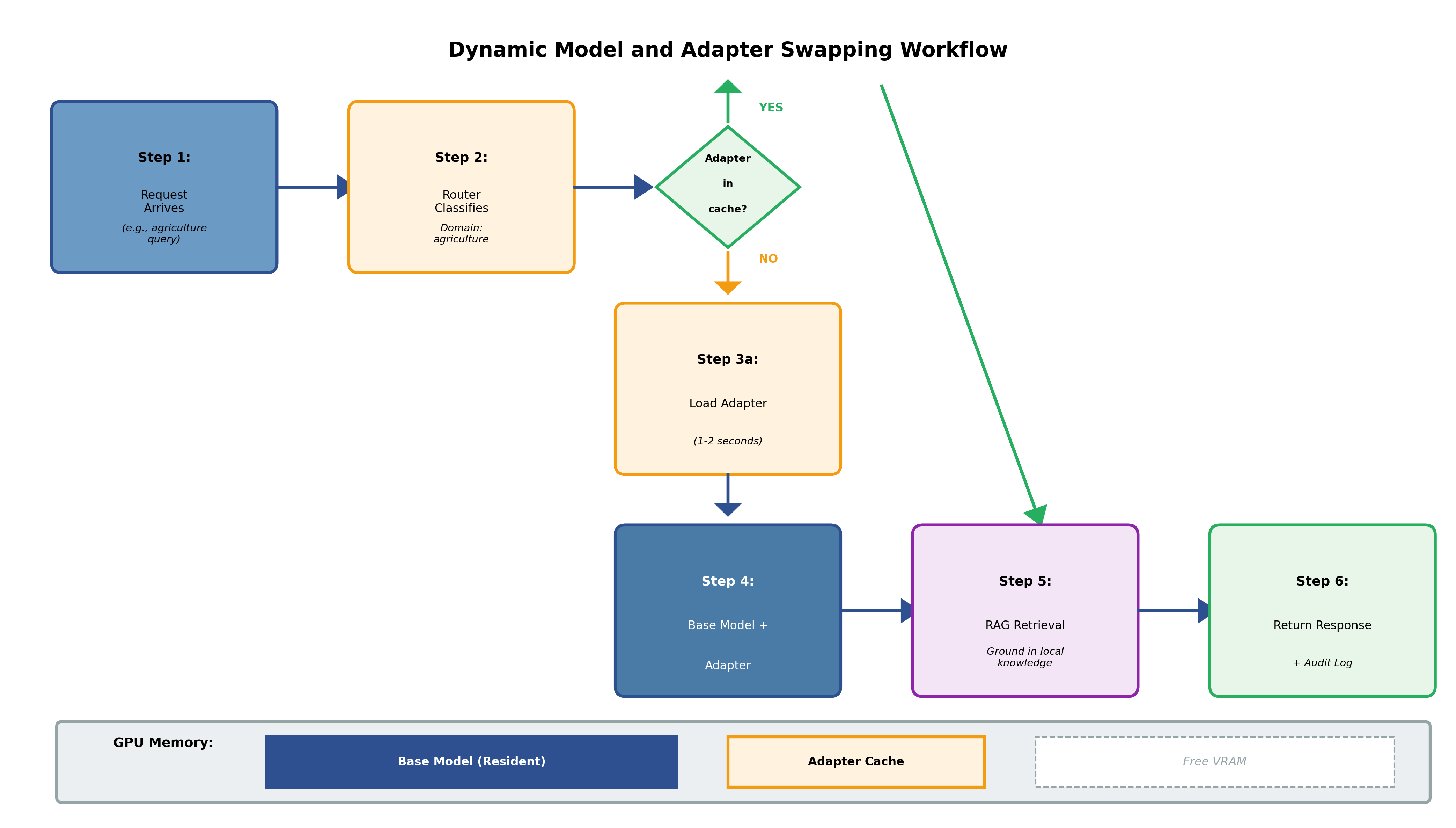
Figure 3. Dynamic model/adapter swapping. The resident base model is specialized on demand by lightweight adapters, with cached adapters skipping the load step entirely.
Training and Adapting Local Models
A cooperative does not need to train a foundation model from scratch — an undertaking costing tens of millions of dollars. Instead, it adapts high-quality open-weight base models to local needs using techniques that are inexpensive, fast, and well within the reach of a small technical team.
Base Model Selection
The open-weight ecosystem in 2026 offers a spectrum of capable, commercially usable models. For everyday interactive workloads, 8-billion-parameter models (for example, Llama 3.1 8B or Qwen 3 8B) run comfortably in 5–6 GB of VRAM at 4-bit quantization and serve many members concurrently on inexpensive hardware [6]. For higher-quality reasoning and drafting, mid-range 14B–32B models fit within a single 24 GB GPU (roughly 16–19 GB at 4-bit) [6]. For the most demanding tasks, 70-billion-class flagships such as Llama 3.3 70B require about 40–43 GB of VRAM at 4-bit quantization and are served across two 24 GB GPUs [6]. This tiering lets the cooperative match model size — and therefore cost and energy — to each task.
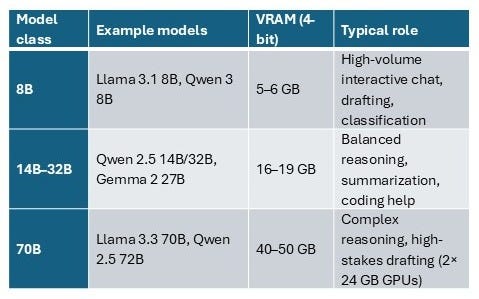
Table 1. Representative open-weight model tiers and their approximate local hardware footprints.
Parameter-Efficient Fine-Tuning (LoRA)
Low-Rank Adaptation (LoRA) and related parameter-efficient methods let the cooperative specialize a base model by training only a small set of additional weights — often less than 1% of the total parameters — while freezing the rest [7]. The resulting adapter is small enough to store and swap in seconds, and training a domain adapter on a curated dataset typically takes hours on a single GPU rather than the weeks and millions of dollars required to train a base model. This is the technical foundation of the swapping workflow in Dynamic Model and Adapter Swapping.
Retrieval-Augmented Generation (RAG)
Fine-tuning teaches a model how to behave in a domain; Retrieval-Augmented Generation supplies it with what is currently true. RAG indexes the cooperative’s curated documents — local regulations, extension-service bulletins, equipment manuals, curricula — into a vector database, then retrieves the most relevant passages at query time and grounds the model’s response in them [8]. This dramatically reduces hallucination, keeps answers current without retraining, and, crucially, ensures that responses reflect local knowledge rather than generic web content.
Federated Learning Across Cooperatives
Federated learning allows multiple cooperatives to collaboratively improve shared models without ever exchanging raw member data [9]. Each cooperative trains locally on its own data and shares only the resulting model updates, which are aggregated into an improved shared adapter. As Figure 4 shows, this enables a network of regional cooperatives to pool the benefits of their collective data while each retains full custody of the data itself — a privacy-preserving embodiment of the cooperative principle of cooperation among cooperatives.
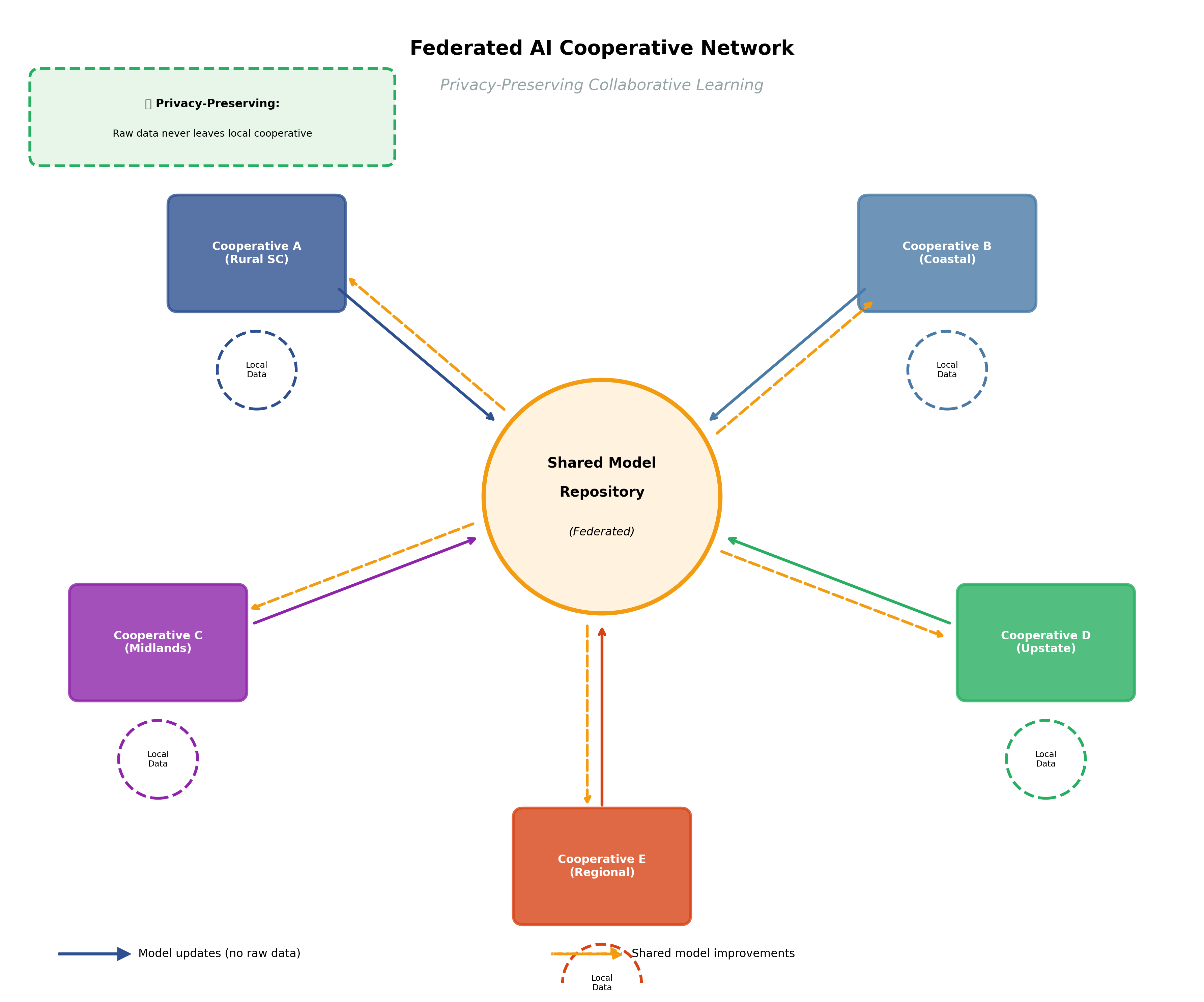
Figure 4. A federated network of regional AI cooperatives sharing model improvements through a common repository while keeping raw member data local.
Curated Datasets, Evaluation, and Versioning
Model quality depends on data quality. The cooperative curates regional datasets with clear provenance and member consent, establishes domain-specific evaluation suites so that every model and adapter is measured against realistic local tasks before deployment, and maintains disciplined version control for models, adapters, and indexes so that any change can be audited and, if necessary, rolled back. This engineering discipline is what turns promising demonstrations into dependable community infrastructure.
Hardware and Infrastructure
The hardware needed to run a capable community AI platform is now well within reach of a rural cooperative’s budget. It requires specific and concrete, current configurations and their operating characteristics.
Deployment Models
Three deployment models are available, and most cooperatives blend them. Local (on-premises) deployment places GPU servers in a cooperative-controlled facility, maximizing data sovereignty, resilience, and long-run cost efficiency. Cooperative-cloud deployment shares infrastructure across a federation of cooperatives to pool capital and expertise. Hybrid deployment runs everyday workloads locally while “bursting” rare, exceptionally demanding jobs to rented cloud capacity. The reference topology in Figure 5 shows a resilient on-premises design with an optional cloud-burst path.
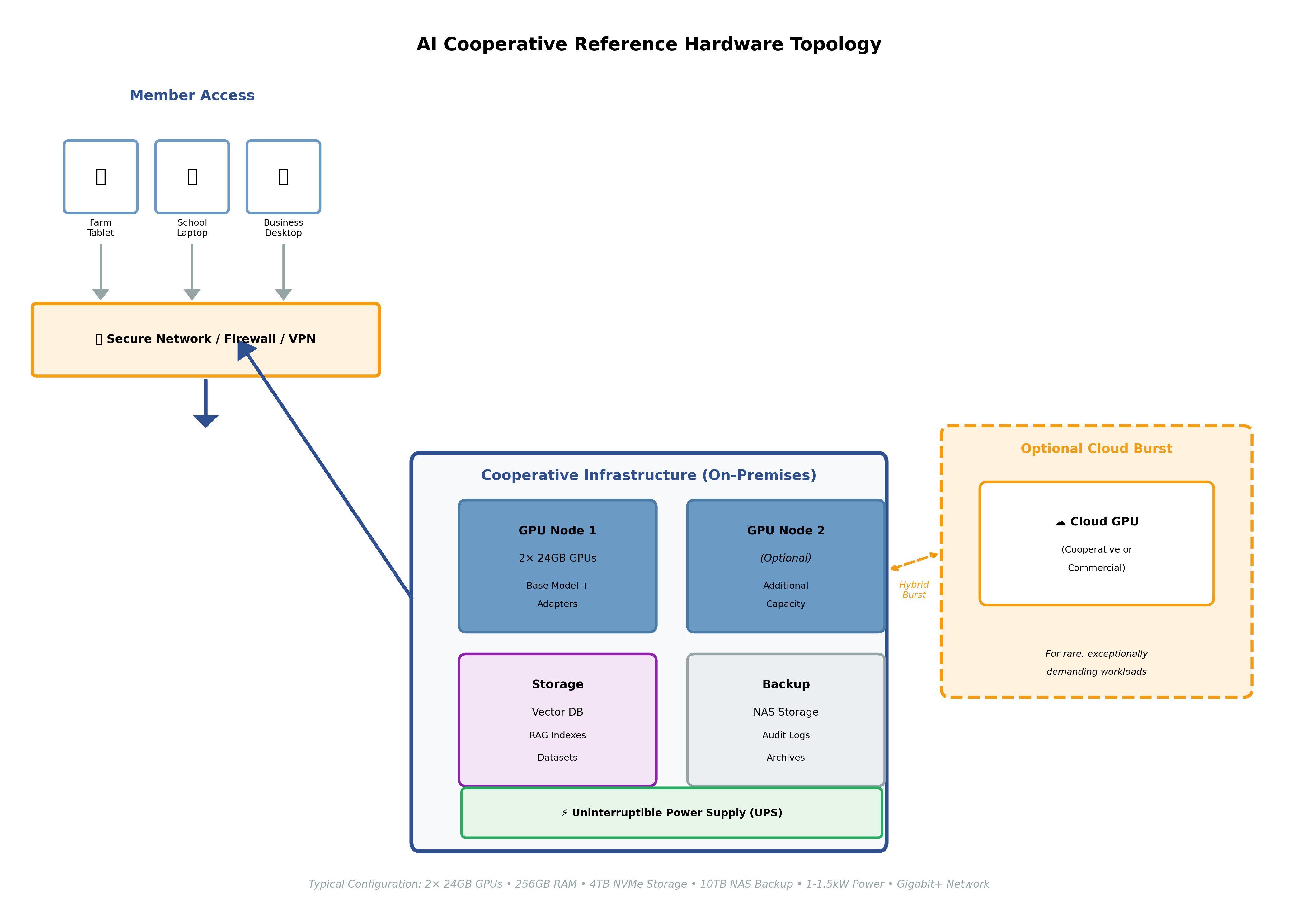
Figure 5. Reference hardware topology for a regional AI cooperative, combining local GPU inference nodes, storage, and secure member access with an optional hybrid cloud-burst path.
Reference Hardware Configurations
Because well-adapted 8B–70B open-weight models cover the overwhelming majority of community needs, a cooperative can build a production platform around consumer- and workstation-class GPUs rather than costly data-center accelerators. A pair of 24 GB GPUs — for example, RTX 4090-class cards at roughly $1,600–$2,200 each [10] — can serve 8B and 32B models directly and a 70B model across both cards. This stands in sharp contrast to data-center H100 accelerators at $27,000–$40,000 each [10], which the cooperative model deliberately avoids for routine work.
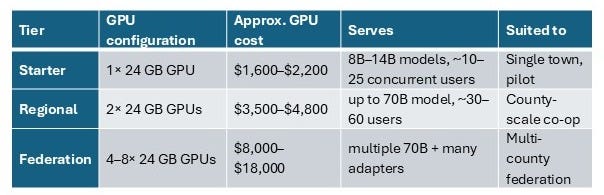
Table 2. Reference GPU tiers for community AI deployment (GPU cost only; add server chassis, CPU, RAM, storage, and networking).
A complete regional-tier node — two 24 GB GPUs, a server chassis with a modern multi-core CPU, 256 GB of system RAM, fast NVMe storage for models and RAG indexes, network-attached storage for datasets and backups, an uninterruptible power supply, and networking — can be assembled for roughly $18,000–$28,000 in hardware. This is the backbone of the economic analysis.
Energy, Cooling, and Networking
Energy is a recurring operating cost, but a modest one at this scale. Whereas an 8-GPU H100 data-center node draws roughly 10 kW and can cost $27,000 to over $100,000 per year to power depending on region [11], a two-GPU cooperative node with supporting equipment typically draws on the order of 1–1.5 kW under load. At a representative U.S. commercial rate near $0.10–$0.12 per kWh, even continuous operation amounts to only a few thousand dollars per year in electricity — an expense many rural cooperatives can offset with the renewable generation several already operate [4], [11]. Standard building HVAC suffices for cooling at this power density, and a business-class broadband connection with cellular failover meets networking needs, with core services continuing locally even during internet outages.
Scalability
The architecture scales gracefully in three directions. Vertically, adding GPUs to a node enables larger models or more concurrent users. Horizontally, adding nodes increases total throughput. Federatively, cooperating with peer cooperatives (Figure 4) shares specialized capabilities and capital. A cooperative can therefore start small — a single starter node serving one town — and grow deliberately as membership and revenue expand, never over-committing capital ahead of demand.
Economic Analysis
This section models the total cost of ownership of a regional AI cooperative and compares it directly with the cost of equivalent commercial AI services. All figures are planning estimates intended to establish order of magnitude; a cooperative should refine them against local quotes and wage rates.
Total Cost of Ownership
A regional-tier cooperative can expect first-year costs of roughly $75,000–$95,000, dominated by one-time capital equipment and setup, followed by annual operating costs of roughly $30,000–$40,000 thereafter. Table 3 breaks down a representative budget.
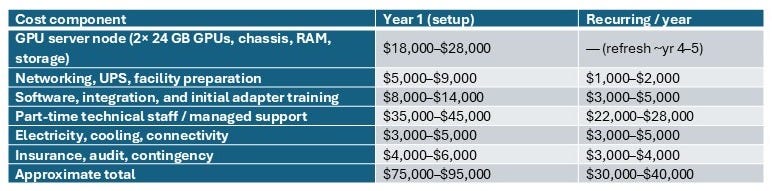
Table 3. Representative total cost of ownership for a regional-tier AI cooperative.
Comparison with Commercial Subscriptions
Consider a community footprint of, say, 60 active professional users across a school district, a county government, several farms, and a few small manufacturers. Equipping them with flagship commercial AI at even a modest $150–$200 per user per month, plus metered API usage for document-heavy and agentic workflows [3], readily exceeds $120,000 per year — a purely recurring expense that produces no owned asset, no local jobs, and no retained data. Figure 6 plots the cumulative cost of both paths over five years.
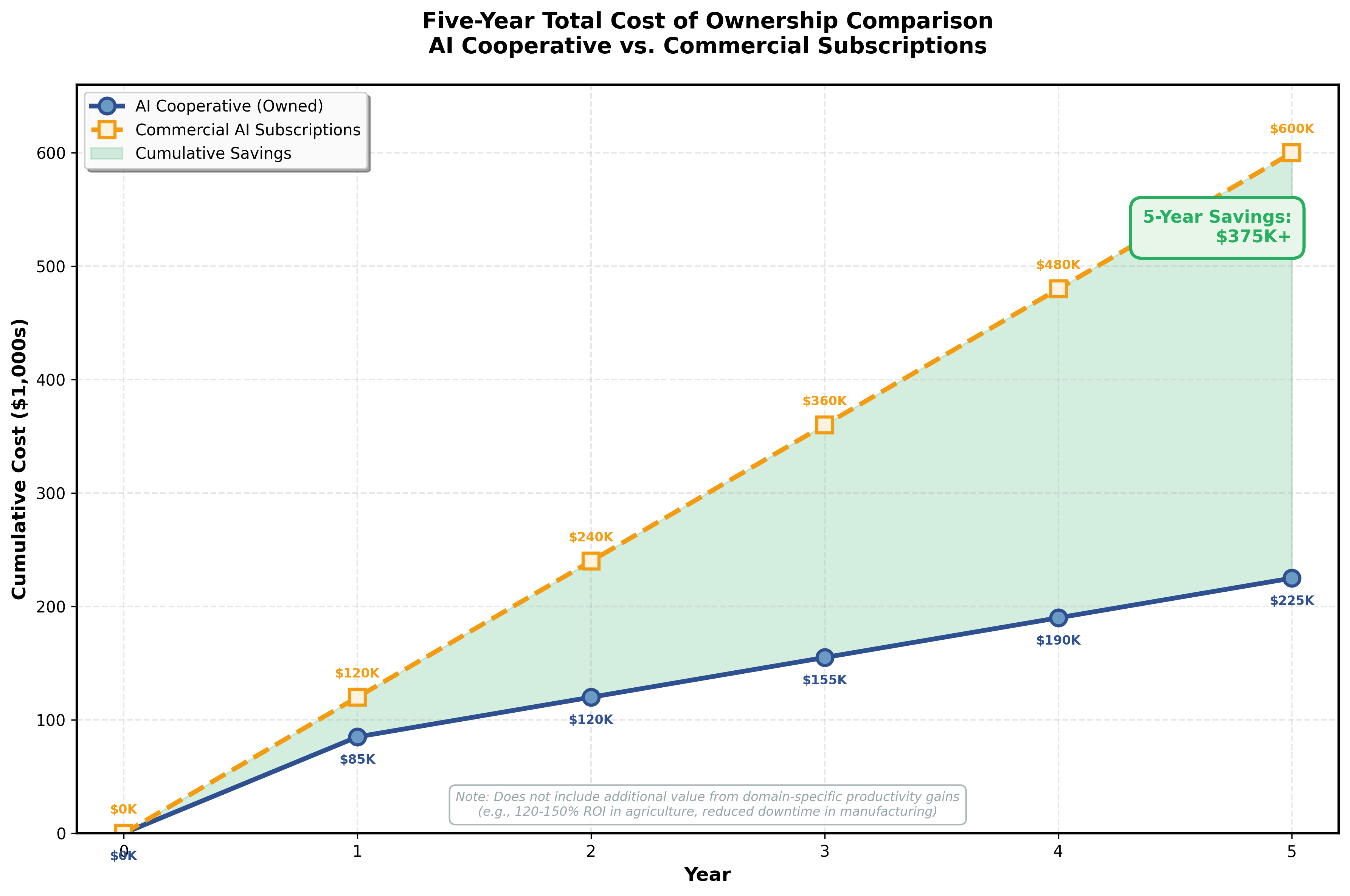
Figure 6. Five-year cumulative cost comparison. The cooperative’s higher first-year outlay is offset within roughly the first year, after which savings accumulate substantially.
Return on Investment and Break-Even
Under these assumptions the cooperative reaches cost break-even within approximately the first year and, over five years, spends on the order of $260,000 cumulatively against roughly $600,000 for the commercial path — a saving of well over $300,000 that stays in the community. These figures count only avoided subscription costs; they exclude the additional value created by domain-specific productivity gains documented in the case studies, which in agriculture alone can reach 120–150% ROI on AI investment [12]. When those productivity gains are included, the case for community ownership becomes overwhelming.
Case Studies
The following four scenarios illustrate how an AI cooperative delivers concrete value. Each follows a problem → solution → impact structure and includes representative cost or efficiency figures drawn from published outcomes for analogous deployments. The scenarios are illustrative but grounded, designed to be achievable with the regional-tier platform.
Agriculture: Crop Planning and Pest Identification
Problem. A network of family farms in the South Carolina Midlands struggles with late detection of pests and diseases and with blanket application of costly chemical inputs. Extension expertise is stretched thin, and the nearest specialist may be hours away.
Solution. The cooperative deploys an agriculture adapter combined with a RAG index of Clemson Cooperative Extension bulletins, local soil and weather data, and pest field guides. Members photograph affected plants with a phone; an on-cooperative vision-and-language pipeline identifies the likely pest or disease and returns a locally appropriate, integrated-pest-management recommendation, along with crop-planning and irrigation guidance grounded in regional data.
Impact. Published outcomes for AI-driven precision agriculture report 20–30% yield increases, 30–50% reductions in crop losses, and 15–50% reductions in chemical, water, and fertilizer inputs, with pests detected 7–14 days before visible symptoms and detection accuracy above 95% [12]. Payback on such AI investments commonly arrives within one to two growing seasons, and small farms report 120% ROI [12]. For a member farm spending $40,000 a year on inputs, a 20% reduction alone returns $8,000 annually — several times the member’s cooperative dues.
Local Manufacturing: Predictive Maintenance and Quality Assurance
Problem. A small rural manufacturer cannot afford the enterprise analytics platforms used by large competitors, yet unplanned equipment downtime and scrap from quality defects erode already-thin margins.
Solution. The cooperative provides a manufacturing adapter that ingests machine-sensor logs and maintenance records to flag anomalies before failure, and a vision-assisted quality-assurance workflow that helps line staff catch defects earlier. All data and models stay on cooperative infrastructure, so proprietary process information never leaves the region.
Impact. By shifting from reactive to predictive maintenance, the manufacturer reduces unplanned downtime and extends equipment life, while earlier defect detection lowers scrap and rework. For a plant where a single hour of unplanned downtime costs several thousand dollars, avoiding even a handful of failures per year comfortably justifies the cooperative membership — and the manufacturer gains capabilities previously reserved for far larger firms.
Regional Education: Tutoring and Curriculum Support
Problem. A rural school district faces teacher shortages and limited access to specialized tutoring, and is understandably wary of sending student data to commercial AI vendors.
Solution. As an institutional member, the district uses an education adapter with a RAG index aligned to South Carolina state standards. Students receive on-demand, curriculum-aligned tutoring; teachers generate differentiated lesson materials, practice sets, and assessments in minutes. Because the platform runs on cooperative infrastructure, student data remains under local, FERPA-conscious control and is never used to train external models.
Impact. Teachers reclaim hours each week from routine material preparation, redirecting that time to direct instruction, while students gain always-available, standards-aligned support that would otherwise be unaffordable. A district-wide institutional contract — a fraction of the cost of per-seat commercial licensing for hundreds of students — provides predictable anchor revenue for the cooperative and equitable access for the community.
Legal Assistance: Document Preparation and Citizen Guidance
Problem. Residents in a rural county face a persistent access-to-justice gap: routine matters such as expungements, benefit applications, landlord-tenant issues, and estate paperwork are hard to navigate, and the nearest legal-aid office is overwhelmed.
Solution. In partnership with a legal-aid organization, the cooperative offers a legal-assistance adapter with a RAG index of relevant South Carolina statutes, court forms, and self-help guides. It helps residents understand procedures and prepare draft documents. The system operates under a strict human-in-the-loop standard — every output is reviewed by a qualified professional, and the tool explicitly provides legal information and drafting support, not legal advice.
Impact. Paralegals and attorneys handle substantially more matters per week when routine drafting and research are AI-assisted, extending scarce legal-aid capacity to more residents. Citizens gain clearer guidance and better-prepared paperwork, reducing costly errors and court delays — a direct improvement in access to justice, delivered under professional oversight and local governance.
Policy Recommendations
Public policy can accelerate the formation of AI cooperatives just as it once accelerated rural electrification and, more recently, broadband expansion. The following recommendations are directed at state and federal policymakers and are designed to be concrete and implementable.
1. Establish AI-cooperative capital grants. Create a dedicated grant program — modeled on USDA Rural Utilities Service financing and on South Carolina’s successful broadband grant framework [2], [4] — to fund the $75,000–$95,000 first-year capital needs of qualifying community AI cooperatives, with matching requirements scaled to local capacity.
2. Extend low-interest cooperative financing. Authorize revolving loan funds and loan guarantees so cooperatives can finance GPU hardware and facility upgrades on affordable terms, mirroring existing rural-utility lending mechanisms.
3. Tie AI readiness to broadband investment. As states deploy remaining BEAD and digital-equity funds, explicitly include community-AI capacity building — shared computing, digital-literacy training, and cooperative formation support — so that connectivity investments translate into usable intelligence, not just pipes [1], [2].
4. Adopt open standards and procurement preferences. Favor open-weight models, open data formats, and interoperable interfaces in publicly funded AI, and grant procurement preferences to community-owned providers for public-sector AI services, keeping public dollars and public data local.
5. Invest in workforce development. Fund technical-college and university certificate programs in local AI operations — model adaptation, RAG engineering, and AI governance — to build the small but essential talent pool each cooperative needs, in partnership with other educational institutions.
6. Seed public-private research collaborations. Support land-grant university partnerships and federated research networks (Figure 4) that develop shared, regionally relevant models and evaluation suites as public goods, so that no single cooperative bears the full cost of foundational work.
Five-Year Roadmap
The path from concept to mature ecosystem is deliberately incremental, allowing each cooperative to prove value and build member trust before committing further capital. Table 4 summarizes concrete, measurable milestones for each year.
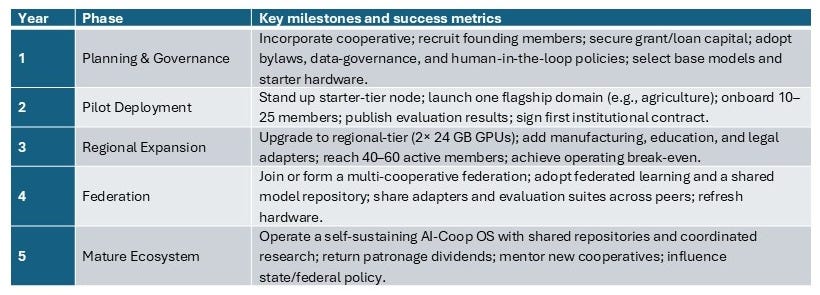
Table 4. Actionable five-year roadmap with measurable milestones.
Conclusion and Call to Action
The intelligence divide is not inevitable. The tools to close it — capable open-weight models, efficient adapters, affordable GPUs, and proven cooperative governance — are available today, and their costs are within reach of the very communities that stand to benefit most. Locally governed AI cooperatives can improve resilience by running critical services on infrastructure the community controls, ensure transparency through auditable operation and open models, secure technical independence from volatile external providers, and drive regional economic development by keeping the value of artificial intelligence — its assets, its data, and its jobs — inside the community. They do this while complementing, not replacing, commercial AI services where those genuinely add value.
A century ago, rural communities refused to wait for distant utilities to decide when — or whether — to bring them electricity. They organized, they cooperated, and they built the infrastructure themselves. The result reshaped rural America. The same choice now presents itself with artificial intelligence. The call to action is direct. To cooperative organizers and community leaders: convene your stakeholders, adapt the governance and financing models in this paper, and stand up a pilot within a single budget year. To policymakers: enact the grant, financing, and workforce measures so that rural communities are not merely consumers of intelligence built elsewhere, but owners of intelligence built at home. The technology is ready, the economics are favorable, and the precedent is proven. What remains is the will to begin — and the invitation of this white paper is to begin now.
References
[1] Federal Communications Commission and BroadbandNow Research, “Broadband deployment and availability data,” Broadband Progress Reports and national coverage audit, 2024–2025. [Online]. Available: https://www.fcc.gov/reports-research/reports/broadband-progress-reports
[2] South Carolina Office of Regulatory Staff, Broadband Office, “South Carolina nears the end of the digital divide,” 2025. [Online]. Available: https://ors.sc.gov
[3] IntuitionLabs and CloudZero, “AI API pricing comparison and enterprise cost analysis,” 2026. [Online]. Available: https://intuitionlabs.ai/articles/ai-api-pricing-comparison-grok-gemini-openai-claude
[4] National Rural Electric Cooperative Association (NRECA), “Electric cooperative fact sheet,” 2025. [Online]. Available: https://www.electric.coop/electric-cooperative-fact-sheet
[5] International Cooperative Alliance and U.S. Department of Agriculture, Rural Development, “Cooperative principles and rural cooperative governance,” USDA Rural Development publications.
[6] “VRAM requirements for local large language models,” LocalLLM and WillItRunAI technical guides, 2026. [Online]. Available: https://localllm.in/blog/ollama-vram-requirements-for-local-llms
[7] E. J. Hu, Y. Shen, P. Wallis, Z. Allen-Zhu, Y. Li, S. Wang, L. Wang, and W. Chen, “LoRA: Low-rank adaptation of large language models,” in Proc. Int. Conf. Learning Representations (ICLR), 2022.
[8] P. Lewis, E. Perez, A. Piktus, et al., “Retrieval-augmented generation for knowledge-intensive NLP tasks,” in Advances in Neural Information Processing Systems (NeurIPS), 2020.
[9] B. McMahan, E. Moore, D. Ramage, S. Hampson, and B. A. y Arcas, “Communication-efficient learning of deep networks from decentralized data,” in Proc. AISTATS, 2017.
[10] IntuitionLabs and DirectMacro, “NVIDIA AI GPU pricing guide,” 2026. [Online]. Available: https://intuitionlabs.ai/articles/nvidia-ai-gpu-pricing-guide
[11] Spheron Network and Slyd, “AI inference power and electricity cost analysis,” 2026. [Online]. Available: https://www.spheron.network/blog/ai-inference-power-electricity-cost-2026/
[12] TensorBlue and StartUs Insights, “AI in agriculture: precision farming, crop monitoring, and ROI,” 2025–2026. [Online]. Available: https://tensorblue.com/blog/ai-for-agriculture-precision-farming-crop-monitoring-yield-prediction-2025
--
Prepared by: Leslie L Aker
© July 2026
Mr. Aker is a computer scientist, consultant, and cryptographer. He has more than 40 years of professional experience working as an innovator and disruptive technologist in advanced technology research and development. He spent most of his career working at the Naval Research Laboratory in Washington, DC, the US Navy’s corporate research facility, founded by Thomas Edison. Mr. Aker worked in the Center for High Assurance Systems. That’s a nice way of saying he has been hacking computers for more than 40 years.